Did AI Just Solve One of Mathematics’ Biggest Problems?
OpenAI’s agents reached a proposed solution in 88 hours. But the human research that came before, and the controversy that followed, raise a harder question: what actually counts as an AI discovery?
以下正文同步自 KDnuggets,版权归原站所有,已转换为易读排版。
Bubeck later said he had proposed Buckmaster as lead author of a rewritten presentation of OpenAI's proof, and that he considered it inappropriate for an Anthropic employee to author OpenAI's work. He also clarified that he had never proposed removing Alpöge from Buckmaster and Alpöge's own Euler paper.
That disagreement points to a problem academic publishing was never really designed for.
If humans develop the surrounding ideas, AI tools participate in the research, another AI system generates the final proof and humans still need to interpret and publish it, who actually gets the credit?
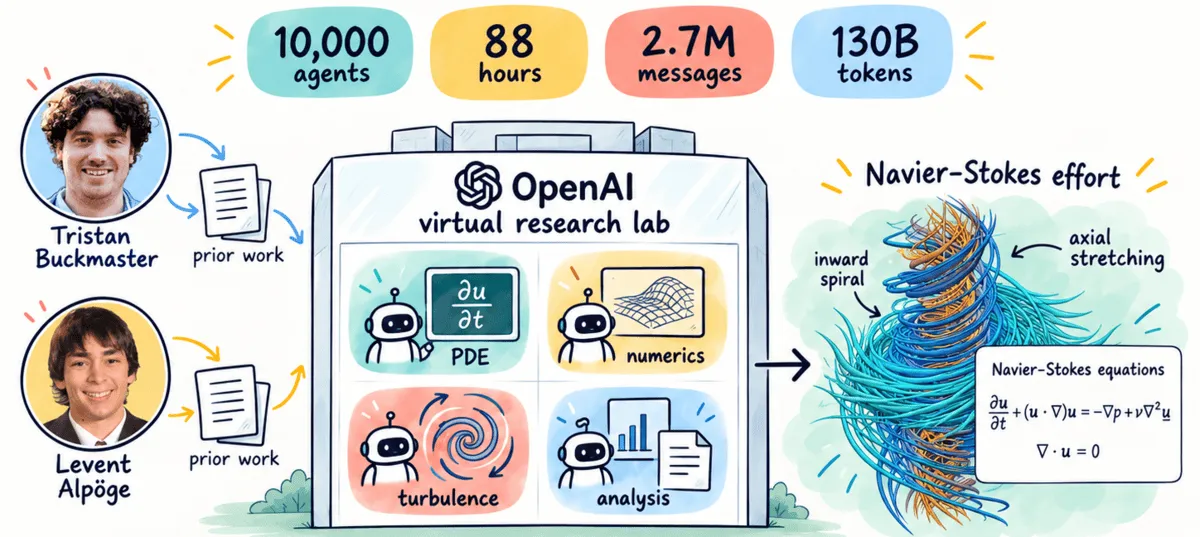
OpenAI's experiment was not 10,000 agents starting from a blank page and inventing fluid dynamics from scratch.
It built on decades of mathematics, recent human progress in the same area, and research directions that were already becoming promising. Humans also decided where to allocate compute, while OpenAI deliberately passed useful intermediate findings between agent groups.
But that does not make the result any less significant.
What OpenAI demonstrated is something different: thousands of AI agents can explore research paths in parallel, discard dead ends, combine promising ideas and compress an enormous amount of work into just a few days.
The Clay Mathematics Institute has since said that the Navier-Stokes problem "has apparently been settled," while making clear that evaluating the result and determining credit will take time.
So perhaps the important question is not whether AI has suddenly reached artificial general intelligence.
What this experiment really shows is that we can now give a very difficult research problem to thousands of AI agents, let them explore many different ideas at the same time, and potentially finish in days what could take human researchers much longer.
正文由 探How 从来源站点 RSS 同步,内容未经改写;遇到排版缺失或需要图片、视频时请以原文为准。