Venice: The Antidote to AI
Founder and Creative Director of STUDIO FLO. Former gallerist, forever curious about the intersection of art, business, and culture.
以下正文同步自 Hacker News 最新,版权归原站所有,已转换为易读排版。
Founder and Creative Director of STUDIO FLO. Former gallerist, forever curious about the intersection of art, business, and culture.
I never left the art world. I simply expanded the canvas.
It's 4:57 a.m. The house is dark. My coffee is hot. Not a creature is stirring, not even a mouse.
Blissfully suspended somewhere between jet lag and a head full of swirling ideas, I've been wooed from my bed to bask in the glow of my computer, trying to make sense of something that followed me home. (The irony of which will become apparent shortly.)
Venice is an extraordinarily beautiful, extraordinarily inconvenient city. There are bridges everywhere. You get lost constantly. A journey that looks like five minutes on a map somehow takes twenty. And when you're carrying a 27-pound toddler on your back, every bridge is a small personal Everest.
But that's part of her magic. You cannot rush Venice. You have to submit to her labyrinth, her rhythms, her peculiar relationship with time. And in doing so, you become part of something ancient, alive, and remarkably persistent.
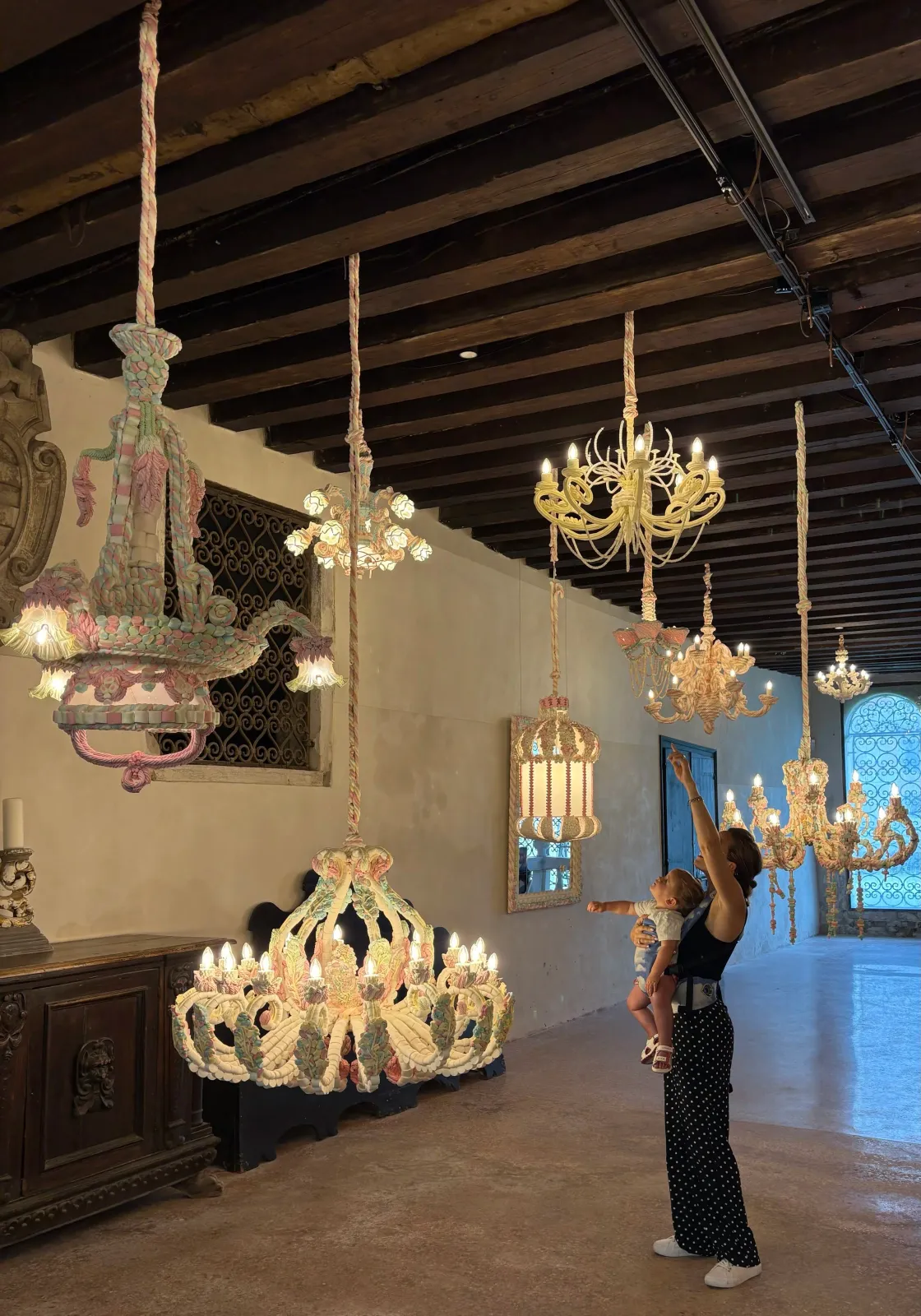
For 10 days, we walked. Some days, 15,000 steps. Through tiny alleyways and grand piazzas, past crumbling facades and illustrious interiors, into palazzos where centuries-old architecture provides the backdrop for contemporary art.
And everywhere, people making things. Not content. Not deliverables. Certainly not deadlines. Actual, tangible things.
I watched a craftsperson through a tiny atelier window, transforming glass into colorful rings, each one a little different from the next. I bought Venetian velvet slippers for Futura and I from a family that has proudly practiced its craft for four generations. And one afternoon, I found myself in a shop with a mother and son whose family has spent some 70 years designing and sewing the perfect white cotton collared shirt.
Seventy years devoted to something most of us consider ordinary.
There's something deeply moving about that. The repetition, the refinement, the accumulated knowledge passed from one pair of hands to another. A lifetime spent getting better at one thing, not because it needed reinventing every season, but because it was worth doing beautifully.
I've been thinking a lot about the value of craft in an age of artificial everything.
We now have extraordinary tools that can write, design, illustrate, and generate in seconds what once took days or weeks. And I use them... or try to. Frankly, I already feel too behind to catch up.
But I keep coming back to a question: When everything can be made instantly, what happens to the meaning of making?
There's a particular texture to human creativity that doesn't always survive optimization. The little irregularities, the unexpected detours, the peculiar choices that nobody would have made except that person, with that history and their particular way of seeing the world.
AI is very good at giving us something polished. But polish isn't perspective, and an immaculate answer isn't necessarily an interesting one. Sometimes the friction is the very thing that gives the work its character.
Think about the painter who spends a lifetime discovering a particular language of color. The glassblower whose hands know precisely when the molten material is ready. The mother and son making white shirts, continuing a conversation with their craft that began long before either of them.
Their expertise lives somewhere deeper than instructions. In their hands, their eyes, their judgment. In a thousand tiny decisions accumulated over decades.
That's not simply technique. That's authorship.
And perhaps that's what we need to protect most.
I don't think the answer is to reject technology, romanticize the past, or insist that everything worthwhile must be done the hard way. (As someone who just hauled a toddler across approximately 1,437 Venetian bridges, I assure you, convenience has its merits.)
But I do think we need to become more intentional about what we outsource. There's a difference between using technology to support your thinking and allowing it to do the thinking for you.
I want AI to handle the things that pull me away from my creative life and my family, not replace the parts that make it meaningful. More time with paper and pen. More conversations that wander somewhere unexpected. More afternoons looking at art, getting lost in a city, or watching Futura discover something for the first time.
I want technology to make my life more human, not my humanity more efficient.
Which brings me to a rather delightful paradox.
I've been experimenting with one simple rule: let technology take care of the administration, but keep the experience.
I've always been a paper-and-pen person. Journals, scribbled ideas, daily to-do lists, margins filled with arrows and thoughts that only make sense to me.
But eventually, all that beautiful chaos needs to find its way into an email, a client document, or my Notion workspace. And the transcription part? Not exactly where the magic happens.
So I've started photographing my handwritten notes and letting AI organize the ideas and help shape first drafts. In fact, this very essay began as a rambling collection of thoughts at 4:57 a.m.
The ideas are still mine. The notebook is still mine. The messy, meandering process is still mine. The filing clerk just got considerably faster.
Travel is another place where I've found AI genuinely useful, especially with a toddler, when spontaneity and logistics are in constant negotiation.
Rather than spending hours researching opening times, navigating routes, or comparing destinations, I can ask for a few thoughtful options suited to our interests and where we happen to be. And then, wonderfully, put the phone away.
Because the best part of Venice wasn't finding the most efficient route between museums. It was everything along the way. The tiny shops, unexpected conversations, the piazza where Futura could run around, the doorway that made me stop.
The technology helped with the logistics. Life happened in the margins.
We spend an extraordinary amount of time on the scaffolding of our lives. Organizing information, sorting notes, making lists, planning logistics, and keeping track of the fifty-seven little things required to run a business, a household, and a life.
I'm interested in using AI to reduce that scaffolding. Not so I can squeeze another three meetings into the afternoon, but so I can have the afternoon.
To read. To make. To play with my daughter. To sit across from someone I love without mentally rearranging tomorrow's task list.
Perhaps the most meaningful productivity improvement isn't doing more. It's having more time to do the things that make us feel alive.
The more I think about it, the more I believe the real question isn't what AI can do for us. It's what we want to remain ours.
Our judgment, curiosity, taste, peculiar obsessions, and hard-earned experience. The perspective that comes from having lived a life nobody else has lived.
I think about those Venetian artisans, carrying forward traditions that have survived wars, changing economies, and centuries of technological progress. They've reminded me that not everything valuable needs to be faster, easier, or infinitely reproducible.
Some things are valuable precisely because they're none of those things.
And maybe the greatest luxury of the future will be choosing what we continue to make, think, and experience ourselves. To remain close to the source. To care deeply. To make something unmistakably human.
So I'm curious: How are you using AI to make more room for the textures of real life? Is it helping you create, think more deeply, spend more time with the people you love? Or are you finding it simply makes room for more work?
Olivia is an artist, curator and designer living and working in Boston & NYC. Blending artistic fluency with a passion for art, branding and design, she specializes in designing visual narratives, exhibition curation and building brands that bring people together around art in the physical and digital world.
正文由 探How 从来源站点 RSS 同步,内容未经改写;遇到排版缺失或需要图片、视频时请以原文为准。